A condo’s HOA fee in Temecula, CA, is not the price of a bargain. The lower overall price buys smaller space, not cheaper space, so the monthly dues have to earn their keep through what they cover.
Key takeaway
Temecula has no published citywide HOA average, so judge each fee by what it replaces. Condos sell for about $269,000 less than houses at the median, but you pay a similar price per square foot plus monthly dues. If the dues cover bills you would otherwise pay yourself, like water or yard care, a condo is the cheaper way in. If they don’t, a single-family home with lower or no dues usually gets you more space for the same monthly total.
Who this guide is for
You are looking at a Temecula home that carries HOA dues and deciding whether the fee is worth it, or whether a condo or a house fits your monthly budget better.
How much are HOA fees in Temecula, CA?
No official citywide average exists for association dues. Each association’s board sets its own amounts based on its operating costs and reserve needs. The real number is on the active listing and is confirmed in the association’s annual budget report. Many homes in Temecula’s master-planned neighborhoods sit in both a master association and a sub-association, so ask the listing agent in writing whether the quoted dues include both layers.
The most useful comparison is between a condo and a single-family house. Over the 90 days ending September 30, 2026, Temecula condos sold for a median of $358 per square foot, based on 13 sales, while single-family homes sold for $354 per square foot.
Condo vs. single-family HOA costs in Temecula
Condos recently showed six months of supply, while single-family homes had 3.5 months. More inventory on the market gives condo buyers time to request HOA documents before committing and room to ask for credits. Condo prices also showed a 17.2% drop year over year, though that figure rests on just 13 sales. Treat it as a reason to compare recent sales in a specific complex rather than proof that prices are falling across the board. Additional context on local inventory is available in our overview of the Temecula housing market.
The monthly cost compounds over time. For illustration only: $300 a month in dues is $3,600 a year and $36,000 over ten years. Weigh that long-term figure against the median price gap between a house and a condo.
Lenders count dues in your monthly housing payment, so each $100 of dues reduces the loan amount you qualify for.
What Temecula HOA fees cover
Monthly dues generally pay for three things: day-to-day operations, reserve funds and sometimes utilities.
- Operations: common-area landscaping, pool maintenance, property management and the master insurance policy.
- Reserves: a savings account for future replacement of major items like roofs, pools and private paving.
- Utilities: water is the one most commonly bundled into Temecula dues. When dues include water, weigh them against what you would pay the local water district directly.
Ask the seller what the dues exclude, whether that is trash collection, cable or roof repairs on detached homes. Also confirm whether the master insurance policy covers the interior or only the structure, so you know whether you need your own walls-in (HO-6) policy.
Associations can also levy special assessments for unexpected repairs or budget shortfalls. Under California Civil Code Section 5605, an HOA board cannot raise the regular assessment by more than 20% over the previous year without approval from a majority of a quorum of members. The same approval is needed for special assessments totaling more than 5% of the budgeted gross expenses for that fiscal year. Civil Code Section 5300 requires the association to distribute an annual budget report and reserve funding disclosure 30 to 90 days before the end of its fiscal year.
What one Temecula condo HOA includes
If you plan to use an FHA loan for a property like this, look up the complex in HUD’s official online FHA-Approved Condominium search tool.
Temecula Creek Village
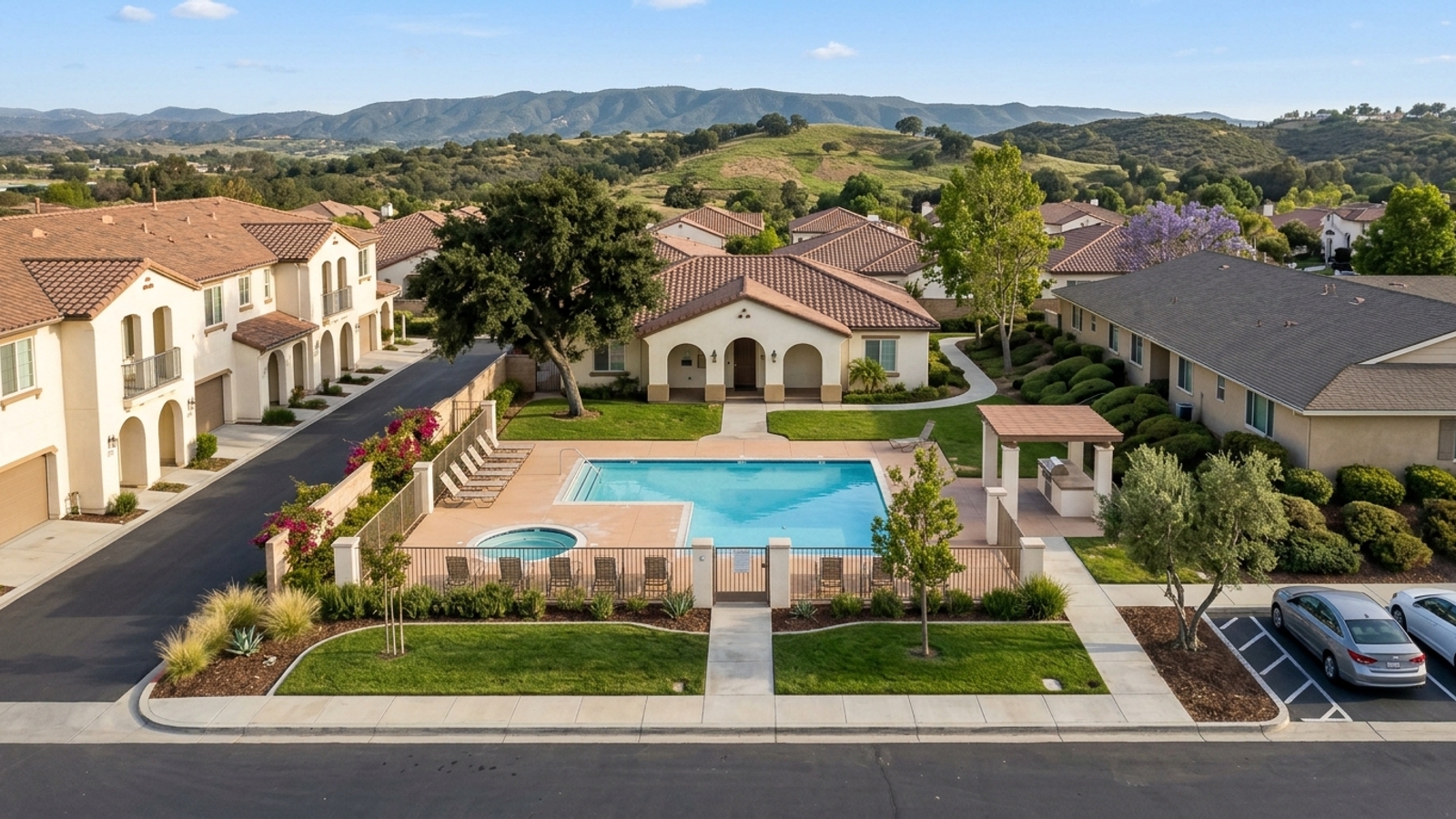
Per an active listing, the association’s amenities include a pool, spa, sauna, barbecue area, clubhouse and gym. The HOA also includes water and maintains the front-yard landscaping. Water and front-yard care are bills a single-family owner pays separately, so compare the dues against those costs, not against zero.
The tradeoff is that a pool, spa, sauna, clubhouse and gym are expensive to replace. That makes the reserve study more important here than at a complex with fewer amenities. Ask the listing agent in writing for the current dues amount and FHA status, along with the budget report.
HOA dues vs. Mello-Roos in Temecula
Before comparing two listings on total recurring cost, check each one for Mello-Roos. This is a special tax from a community facilities district, and it appears on the property tax bill, not the HOA statement. Lenders count it alongside your dues when calculating your monthly payment. A listing with low dues and a Mello-Roos charge can therefore cost more per month than it looks.
Under Proposition 13, California’s base property tax rate is capped at 1% of full cash value, collected by Riverside County. Actual tax bills often add voter-approved debt or special district charges like Mello-Roos on top of that 1% base. The City of Temecula’s Public Financing Authority oversees multiple community facilities districts, including Harveston, Wolf Creek, Crowne Hill and Roripaugh Ranch. These are obligations of the individual property owners.
The Riverside County Assessor has no control over these assessments, so questions go to each levying district; the tax bill lists a phone number for each one. Look up the current tax bill for the exact parcel in the Riverside County Treasurer-Tax Collector’s online Property Search tool to see these line items. Josh Painter at Impact Real Estate can pull the tax bill and HOA statement for an address so both charges sit side by side.
How much is too much for an HOA fee?
A fee is too high if it fails three tests: what the dues replace, whether the reserves are funded, and whether the dues plus any Mello-Roos still fit your lender’s payment limits. If your constraint is the purchase price, condos are the entry point. If it is the monthly total, run the dues arithmetic from the cost section first.
Before you write an offer, confirm that the association can produce a current reserve study and that no special assessment is pending. If the replacement value threshold is met, California Civil Code Section 5550 requires the board to have the accessible major components visually inspected for a reserve study at least once every three years.
Sellers must provide a resale document package that includes the budget, reserve study, CC&Rs and disclosures about pending assessments or litigation. Read the last 12 months of board minutes for planned projects, ask whether a special assessment has been discussed, and check the CC&R rental rules if you might rent the home later. Josh Painter can request and walk through the HOA documents with you during escrow.
At a glance
- Condo median sale price: $479,951 (90 days ending Sept. 30, 2026; based on 13 sales).
- Condo median sale price change year over year: -17.2% (same window; based on 13 sales, so treat with caution).
- Condo median price per square foot: $358 (same window; 13 sales).
- Condo median days on market: 54; months of supply: 6; homes for sale: 26 (same window).
- Condo sale-to-list ratio: 100.1%, with 15.4% sold above list (same window; 13 sales).
- Single-family median sale price: $748,702, up 0.5% year over year (90 days ending Sept. 30, 2026; 298 sales).
- Single-family median price per square foot: $354 (same window).
- Single-family median days on market: 44; months of supply: 3.5; 29% sold above list (same window).
- All homes median sale price: $735,900, up 0.8% year over year (same window; 318 sales).
Temecula HOA fees FAQs
How do HOAs work in Temecula, California?
Temecula associations operate under California’s Davis-Stirling Act (Civil Code Sections 4000 to 6150), which governs common interest developments, including governing documents, assessments, meetings and elections. An elected board sets the budget, the CC&Rs set the rules, and owners pay assessments to fund operations and reserves.
Is a $600 HOA fee too much in Temecula?
A $600 monthly fee equals $7,200 a year. Whether that is too much depends on what it replaces, such as water, landscaping, exterior insurance or amenities, and whether the reserve study and budget report show funded reserves.
What are the new HOA requirements in California for 2026?
Starting January 1, 2026, SB 410 extends the balcony and deck inspection requirement to condo buildings with three or more attached units and requires sellers to disclose the most recent inspection report. SB 770 drops the requirement to name the HOA as an additional insured on EV charging station insurance, and AB 1170 makes code-maintenance changes to election procedures.
How much are HOA transfer fees in Temecula?
Ask the association or management company for its current fee schedule, and agree in the purchase contract who pays each charge as part of your buyer closing costs.
Can you lose your Temecula home over unpaid HOA fees?
Yes. Under Civil Code Section 5720, a California HOA generally cannot foreclose on an assessment lien unless one of two conditions is met:
- Amount: the delinquent regular and special assessments total at least $1,800, not counting late charges, fees, interest and collection costs.
- Time: the assessments are more than 12 months delinquent.
Request a payoff statement in escrow so prior balances are cleared before you buy.
What is the most a California HOA can fine you?
AB 130, effective June 30, 2025, amended Civil Code Section 5850 to cap most HOA fines at the lesser of the association’s fine schedule or $100 per violation. A higher fine is allowed only if the board makes a written finding at an open meeting that the violation poses a health or safety impact. The law also bars late charges or interest on fines, and the board must provide notice and a hearing before imposing one.
Can an HOA evict you if you own your home in Temecula?
An association cannot evict an owner the way a landlord evicts a tenant. Under Civil Code Section 5725, fines alone cannot trigger a nonjudicial foreclosure (trustee sale), though the association can pursue them in court. Its enforcement tools are fines, liens on unpaid assessments and court action.
Are HOA fees in Temecula paid monthly or yearly?
Most associations bill assessments monthly, with due dates set by each association’s budget. Under Civil Code Section 5650, assessments are delinquent 15 days after they become due unless the declaration allows longer. The association may then add a late charge of up to 10% or $10, whichever is greater, plus interest of up to 12% a year starting 30 days after the due date.
Sources
- Redfin: Data Center
- MLS listing #260024732SD (active null)
- Davis-Stirling.com: Civil Code 4000
- California Legislative Information: Civil Code 5720
- California Legislative Information: Civil Code 5725
- California Legislative Information: Civil Code 5850
- California Legislative Information: SB 410
- California Legislative Information: Civil Code 5605
- California Legislative Information: Civil Code 5300
- California Legislative Information: Civil Code 5550
- California Legislative Information: Civil Code 5650
- HUD: FHA-Approved Condominiums
- City of Temecula: Debt Management
- Riverside County: Special Assessments
- California Legislative Information: Constitution Article XIII A